
Guides
Persian Miniature Painting: Art, Themes & Craft Explained

Persian miniature painting packs centuries of skill into a single leaf of paper. If you love rare art that tells a story in a tiny frame, keep reading: we’ll walk through what it is, how it’s made, the motifs you’ll see, and how to collect it wisely.
What Is Persian Miniature Painting?
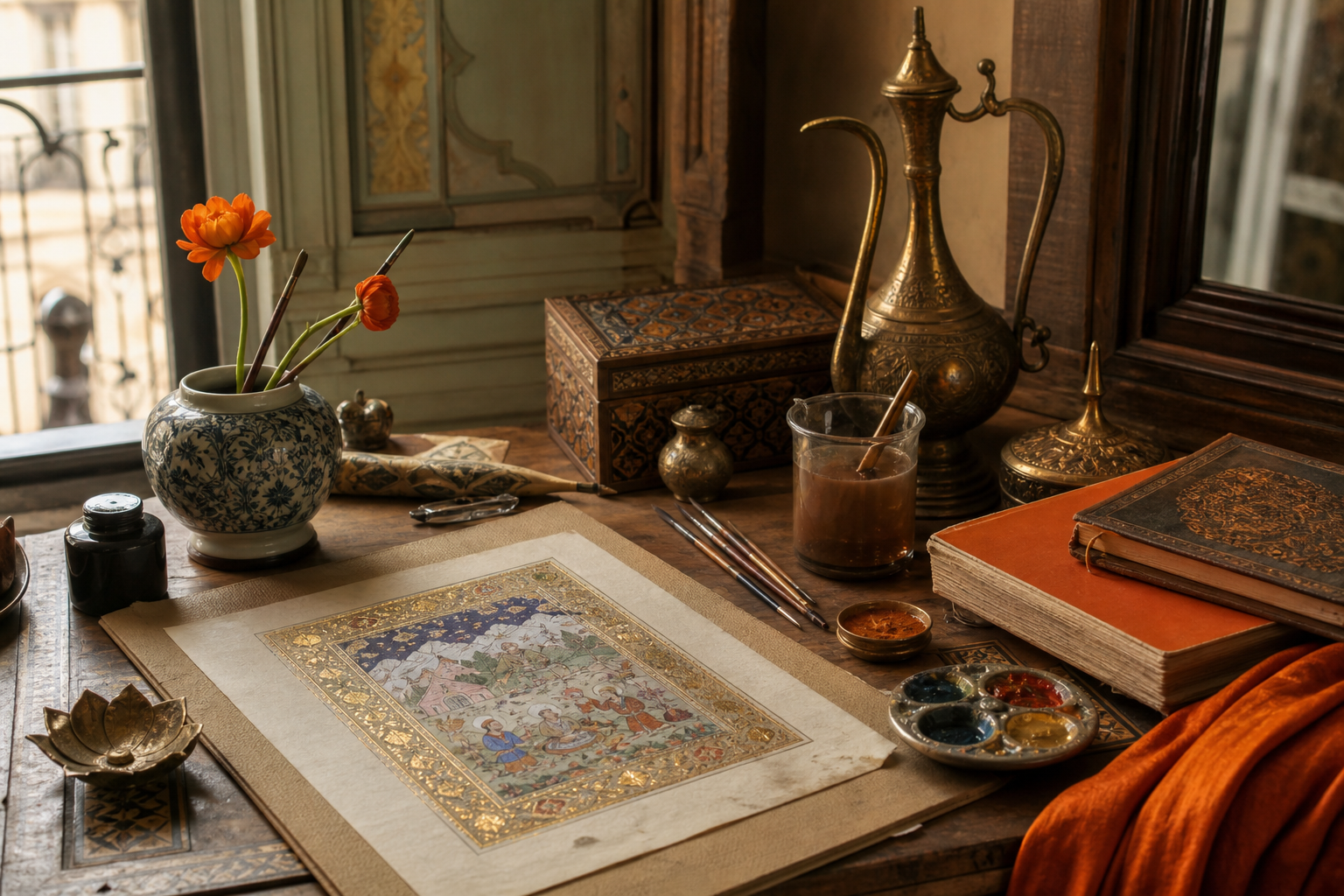
Persian miniature painting is a fine‑scale art form that decorates manuscript pages, albums, and later standalone objects. It relies on meticulous brushwork, vibrant pigments, and often gold leaf to create dense, narrative scenes. The tradition began in the 13th‑century Ilkhanid courts and evolved through Timurid, Safavid and later schools.
Today collectors prize these pieces for their rarity and the way they capture Persian literary and courtly life in a single glance.
How Persian Miniature Painting Builds Its Visual World
Each miniature begins with a prepared surface, often paper coated with a thin gesso layer. Artists mix pigments from mineral oxides (lapis lazuli for blue, cinnabar for red) with a binding medium like gum arabic. Gold leaf is applied in fine sheets, then burnished to a mirror shine.
The brush is tipped with a single hair, allowing strokes as thin as a hair’s breadth. Layers of color build up gradually, creating depth without the illusionistic perspective common in Western art. The flat yet richly patterned style lets artists pack narrative detail into a compact field.
Because the work is so small, the artist must plan every element before laying ink. Sketches are traced in charcoal, then the final drawing is inked, colored, and gilt in a sequence that leaves no room for error.
Modern artisans who recreate the look for decorative objects often follow the same steps, substituting high‑quality acrylics for traditional pigments while preserving the hand‑painted feel.
The Themes and Stories Found in Persian Miniature Painting
Miniatures act as visual storytellers. Common subjects include episodes from the Shahnameh (the Persian epic), courtly romance, hunting scenes, and Sufi mysticism. Women in lush gardens, heroic battles, and celestial beings appear again and again.
Many surviving works are unsigned, so attribution usually rests on the style of the school rather than on an artist’s name.
Because so many pieces are anonymous, collectors rely on stylistic clues, such as the elongated faces of Timurid painters or the bold colour blocks of Safavid pieces, to attribute a work to a particular workshop.
At Pilardi we work with Isfahan artisans who paint tiny scenes on decorative trays and mirrors, echoing those historic motifs while giving each object a one‑of‑one identity.
Persian Miniature Painting Beyond the Manuscript
While the original context was the illumination of books, the aesthetic migrated to standalone objects in the 19th‑century. Today you’ll find miniatures on ceramic tiles, wooden boxes, mirrors, and even luxury game boards.
These objects let collectors enjoy the art without needing an entire manuscript. A hand‑painted decorative tray can serve as a functional surface and a conversation piece, showing a tiny battle scene under a glass top.
Pilardi’s Persian Trays & Home Accents collection showcases this transition: each tray bears a unique miniature scene, framed by the brand’s signature khatam‑kari marquetry.
Because each piece is one‑of‑one, the artwork retains its rarity while gaining a new life in a domestic setting.

How to Appreciate, Collect and Display Persian Miniature Painting
First, verify provenance. Look for museum or auction records. Documented history can raise confidence in a work’s provenance and value.
Second, examine condition. Check for pigment fading, gilt loss, or paper brittleness. Light exposure can dull the blues and reds, so store works away from direct sunlight.
Third, consider framing. A simple, low‑gloss frame protects the edges while keeping the piece flat against a wall. For objects like trays, a glass top guards the surface without hiding the art.
When buying, ask the dealer for any research notes on the school, period, and technique. Because many miniatures lack artist signatures, the scholarly context helps you gauge authenticity.
For those who want to try their hand at the craft, quality brushes and pigments are essential; consult a practical supplies guide for general orientation.
Finally, display with intent. Place the piece at eye level in a quiet corner, where viewers can linger. Pair it with a Pilardi hand‑painted decorative tray to create a themed vignette that highlights both function and fine art.
FAQ About Persian Miniature Painting
What size are most Persian miniatures?
Most miniatures measure between 10 cm and 20 cm on their longest side, making them ideal for intimate viewing or framing in a study.
Are Persian miniatures always on paper?
While paper was the dominant medium, artists also painted on silk, vellum, and later on wood panels or ceramic tiles.
How can I tell if a miniature is genuine?
Look for documented provenance, characteristic pigment use (like lapis lazuli for blue), and stylistic markers of a known school; expert appraisal adds confidence.
Do modern artisans still use traditional pigments?
Many contemporary makers use high‑quality acrylics that mimic historic mineral pigments, but they still apply gold leaf and follow the same brush techniques.
Can I display a miniature in bright light?
Direct sunlight can fade the vivid reds and blues, so it’s best to place the work in indirect light or behind UV‑filtering glass.
Conclusion
For collectors who value rarity and craftsmanship, Persian miniature painting offers a compact portal into a rich visual tradition. Several of our hand‑painted pieces, including the miniature art tray above, sit in the Handmade Gifts Under €200 collection. Explore Pilardi’s one‑of‑one pieces and learn more about styling Persian décor in our Persian Decor styling guide.


