
Guides
Persian Tablecloth: What It Is and How to Use It

A Persian tablecloth made in the ghalamkari tradition is one of the few objects that carries an entire craft on its surface. Each one is printed by hand, block by block, by specialist artisans, and no two come out identical. If you are looking at one and wondering what you are actually holding, this guide explains the craft, the motifs, and how to use it well.
What Is a Persian Tablecloth?
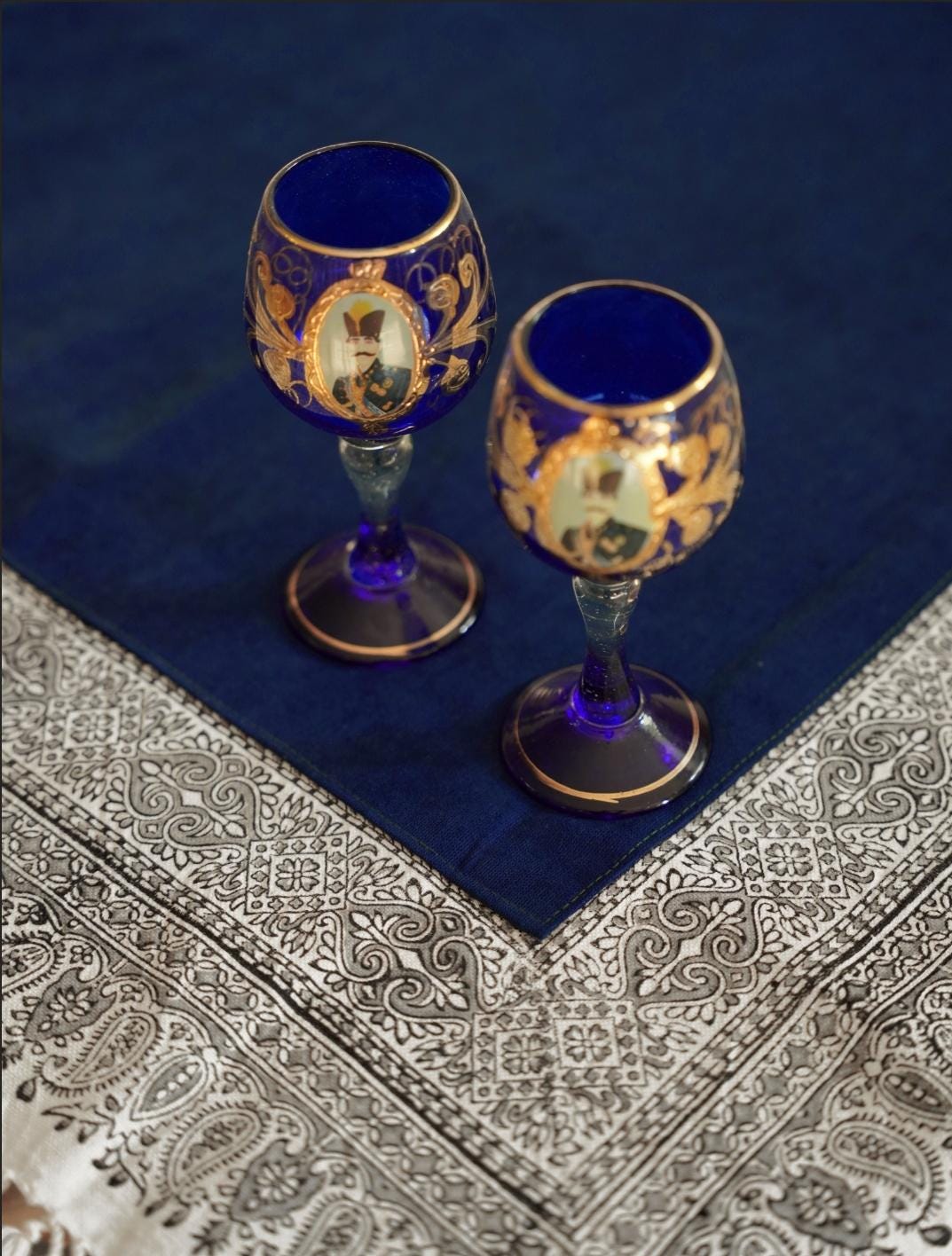
A Persian tablecloth, in the traditional sense, is a piece of hand block-printed cotton made using a technique called ghalamkari. The fabric is printed with carved wooden blocks pressed one at a time across the surface, building up a pattern repeat in hand-mixed natural pigments. It is functional as a table covering, but it is also a textile object in its own right.
What separates a ghalamkari tablecloth from an ordinary printed cloth is how it is made. There is no screen, no roller, no digital file. A craftsperson presses a hand-carved wooden block into pigment and stamps it onto the fabric, then repositions and stamps again, building the pattern motif by motif. Because human hands apply each impression, the pressure varies slightly. The join between one block and the next may shift. The colour may sit lighter in one area than another. These small irregularities are the signature of an authentic piece, not a flaw.
At Pilardi, the hand-printed tablecloths and textiles are made this way by specialist artisans and curated in Paris before shipping. They are produced in small batches, so the exact arrangement of pigment depth and block registration on your cloth is not repeated exactly on any other.
The Craft Behind Ghalamkari Block Printing
Ghalamkari is the Persian name for this hand block-printing tradition. Block printing itself is a centuries-old textile art, and the core process has not changed in its fundamentals.
It starts with the block. A craftsperson carves a design into a wooden block, cutting away the negative space so the pattern stands in relief. A single cloth may require several different blocks used in sequence, each one adding a layer of the design. A floral repeat, for instance, might use one block for the main bloom, another for the stem and leaf, and a third for a border detail.
The cotton is stretched and prepared, then the artisan loads the block with hand-mixed natural pigment, positions it by eye and by feel, and presses it down. Each layer of colour is applied individually and aligned by hand. This is slow work, and it is the reason the finished surface has a rhythm that machine printing does not.
Because every impression is placed by hand, you can expect lighter print areas, small misalignments and softened outlines. Pilardi describes these as authentic signatures of the maker rather than defects, and the same language appears across the range. You can read more about how this textile tradition works on the table in Ghalamkari: The Table as a Living Surface.
Motifs and Patterns: Reading a Persian Tablecloth
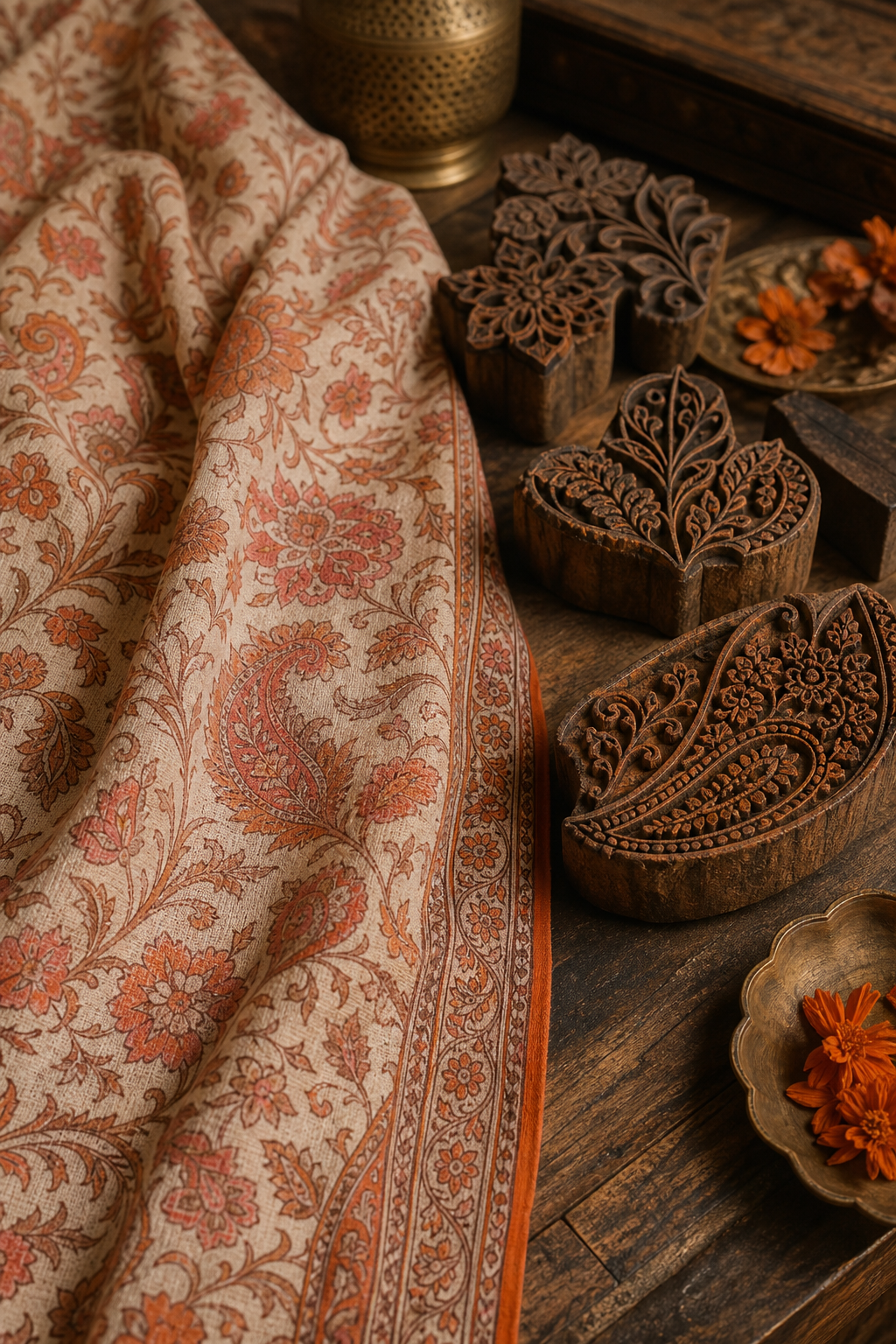
Persian decorative arts have a visual grammar that repeats across objects, from tilework to carpet to textile. Once you know what to look for on a ghalamkari tablecloth, the surface starts to read as a language rather than just a pattern.
The Paisley (Boteh)
The teardrop shape with a curved tip, known in the West as paisley and in Persian as boteh, is one of the most common motifs in ghalamkari printing. It appears solo, mirrored, or nested inside larger repeating units. It works as a dense, interlocking element that fills a composition without visual chaos. You can see it carrying a whole design on the Block Printed Cotton Textile in Floral Paisley, Pink.
Floral Repeats
Floral repeats are the backbone of the tradition. The blooms are stylised rather than botanical, and they repeat across the cloth in a measured grid or a flowing vine. The Sabz Green tablecloth shows this in a single grounded botanical green, while the Indigo (Nilgoun) tablecloth gives the same idea a cooler, more graphic reading.
Border Registers
Many ghalamkari cloths have a distinct border that frames the central field, often printed with a narrower block. It gives the cloth a finished, formal quality and helps it read as a composed object on the table rather than a piece of yardage cut to size. On the larger 100 by 150 cm textiles, such as the Firouzeh Spread and the Bahar in pink and terracotta, the edges are finished with hand-knotted fringe.
Central Medallions
Some pieces are built around a single central emblem rather than an all-over repeat. The Monochrome Floral tablecloth carries a Shamseh, or sunburst, motif at its centre, a form long associated with light and harmony in Persian decorative art.
Horse and Animal Motifs
A few designs include figurative scenes. The Horse and Paisley textile combines horse-and-rider scenes with paisley borders and floral geometry, which is unusual in contemporary block printing, where abstract repeats dominate.
How to Style a Persian Tablecloth at Home
A ghalamkari cloth works in more situations than you might expect. The instinct is to save it for a formal dinner, but that undersells it. Here is how the same cloth can function differently depending on how you use it.
Full Drape for a Dining Table
The most straightforward use is a full drape on a dining table. Choose a cloth that overhangs the edges enough to frame the table without pooling on the floor. The pattern carries the table's visual weight, so you need less on top of it. Simple glazed ceramics, unglazed earthenware, or clear glass work well. The tablecloth does the decorative work and the tableware steps back.
Runner-Style Fold for a Modern Table
If your table is large or your room is minimal, fold the cloth lengthways and lay it as a runner down the centre. This concentrates the pattern and leaves the natural wood or stone of the table visible on either side. It is a way to use a square cloth such as the Reversible 100 by 100 cm tablecloth on a longer table without awkward proportions.
As a Wall Hanging
A cloth with a strong border can be hung flat against a wall as a textile panel. This works especially well in a bedroom or a study. Use a simple wooden dowel threaded through a folded hem, or attach it with fabric clips to a picture rail. The larger textiles are described by Pilardi as suitable for the table, the bed, or the wall, so this is not an improvised use.
Layered on a Console or Sideboard
Draped over a console, the cloth adds pattern to a surface that tends to collect miscellaneous objects. The round 81 cm cloth is a good size for this, and it also suits coffee tables and tea settings. A single cloth under a lamp, a hand-painted miniature tray and a khatam box creates a composed still life, with the textile as the base layer.
Beyond the Table
The same printing is used on other pieces in the range. The block printed cotton cushion covers pick up the pattern on a sofa or bed if you want the motif to carry through a room rather than sit on one surface.
Choosing the Right Size and Colorway
Size is the decision most people get wrong. They buy for the table as it sits, not for how they actually use it. A cloth that barely covers the surface looks sparse. One that drapes to the floor is hard to sit at comfortably.
A useful rule of thumb: add roughly 40 to 60 cm to both the length and width of your table for a comfortable overhang, or add about 40 cm to the diameter of a round table for a modest drop. If a piece is smaller than that, it still works beautifully as a layer over a plain undercloth or as a centrepiece.
Colourway matters as much as size. The Indigo, or Nilgoun, colourway reads as clean and graphic and works in rooms with cooler light or pale stone surfaces. Sabz Green is a botanical green, better suited to warm wood tones or earthy plaster walls. The Bahar palette of pink, terracotta, mustard, turquoise and deep forest green is warmer still, and it suits rooms where the light leans amber in the evening. If you are uncertain, ask for a photograph of the specific cloth you are considering in natural daylight before you commit.
Because each piece is printed by hand in small batches, the exact colour balance and block placement vary from one cloth to the next. If you need precise measurements for a particular table, check the product page and contact Pilardi before ordering. Every piece ships from Paris with tracked delivery, and international shipping is available.
Caring for a Hand-Printed Cotton Tablecloth
Care instructions differ slightly from piece to piece, so always follow the guidance on the product page for the cloth you own. Across the hand block-printed cotton range, the advice is consistent in its essentials.
Wash cool and gently. Pilardi's tablecloths and textiles are listed for hand washing or a cold, gentle or delicate machine cycle with a mild detergent. Some pieces, including the square tablecloths and the round cloth, are listed for hand wash or a gentle cold cycle specifically, so check before putting one in the machine.
Do not bleach. This is stated across the range, and it is the single instruction most likely to cause irreversible damage if ignored.
Air dry where possible. Air drying is recommended to preserve colour richness, and drying away from direct sunlight is advised for the Sabz Green cloth in particular. Some of the larger textiles also allow tumble drying on low.
Iron on the reverse. A warm iron on the back of the cloth is the listed method where ironing is needed. Pressing the printed face directly is not recommended.
If you are storing a piece between uses, fold it loosely and keep it away from prolonged direct light.
FAQ
What makes a Persian tablecloth different from a regular printed tablecloth?
A Persian ghalamkari tablecloth is printed by hand using carved wooden blocks pressed one at a time into the fabric, with hand-mixed natural pigments. The result has slight variations in colour depth and block alignment that a machine-printed cloth will not have. Those irregularities are the visible proof of hand production. The motifs also draw on a specific artistic tradition, typically floral and paisley designs rooted in Persian decorative art.
How do I know if a ghalamkari tablecloth is authentic?
Look at the edges of the motifs under good light. Hand block printing shows softened outlines, occasional faint join lines where one impression meets the next, and areas where the pigment sits lighter. Machine prints tend to be uniformly sharp and consistent across the whole cloth.
Can I use a Persian tablecloth every day, or is it decorative only?
You can use it regularly. The cotton is washable within the care guidance on each product page, which means cool water, mild detergent and no bleach. Many people rotate a ghalamkari cloth with simpler table linens to preserve the print. It works as an everyday cloth, an occasion cover, or a permanent decorative layer on a console or sideboard.
What size Persian tablecloth do I need for a rectangular dining table?
As a rule of thumb, add 40 to 60 cm to both the length and width of your table for a comfortable overhang. Pilardi's larger hand-printed textiles are 100 by 150 cm, which suits a smaller rectangular table for a full drape and works as a runner or layered covering on longer ones. The square tablecloths are 80 by 80 cm and 100 by 100 cm, and the round cloth is 81 cm in diameter.
Where are Pilardi's Persian tablecloths made?
Pilardi's hand-printed tablecloths and textiles are made by specialist artisans using the ghalamkari block-printing technique. They are then curated in Paris and shipped from there worldwide.
Can a ghalamkari tablecloth be hung as a wall textile?
Yes. A cloth with a strong border works well as a wall panel. Thread a wooden dowel through a folded hem at the top edge, or use fabric clips on a picture rail. The 100 by 150 cm textiles are described as suitable for the wall as well as the table. Keep any hand-printed cloth out of prolonged direct sunlight.
Conclusion
A ghalamkari tablecloth is a rare case where something fully functional is also worth collecting. The craft is specific, the provenance is clear, and no two cloths come out the same. Browse the Hand-Printed Persian Tablecloths collection to see the sizes, colourways and motifs currently in stock, or explore the full Pilardi collection of handcrafted Persian objects. Every piece is handmade, curated in Paris, and shipped worldwide with tracked delivery.


