
Guides
How to Decorate a Coffee Table in 6 Steps

A plain coffee table can look finished in minutes, but the order matters. Start with a base, then build height, light, texture, and purpose around it. I’m Anahita, founder of Pilardi, and these are my six steps for styling a coffee table that feels lived-in rather than staged.
Most styling guides begin with a tray. There’s one small twist here: the tray itself sits on the table first. From there, you can add books, greenery, candles, coasters, and one object with a story.
Step 1: Start With a Tray or Base
The first step in learning how to decorate a coffee table is to give the arrangement a clear footprint. A tray gathers small objects into one visual group. It also leaves part of the table free for drinks, snacks, or a board game.
Choose a tray that fits the table without reaching too close to every edge. On a rectangular table, place it slightly off center if the room already has a strong central line. On a round table, keep the base centered and let its shape echo the tabletop.
Look at the finish before you add anything else. A pale tray can stand out against dark wood. A deeper wood tone can calm a glass or stone surface. Texture helps too. A smooth table with a textured base has more visual depth than a flat arrangement placed straight on the surface.
At Pilardi, I often begin with the Hand-painted decorative tray. It is a small art tray with a hand-painted Persian miniature design, so it can hold useful objects while still reading as a collectible piece. I place it directly on the coffee table, then build around it.
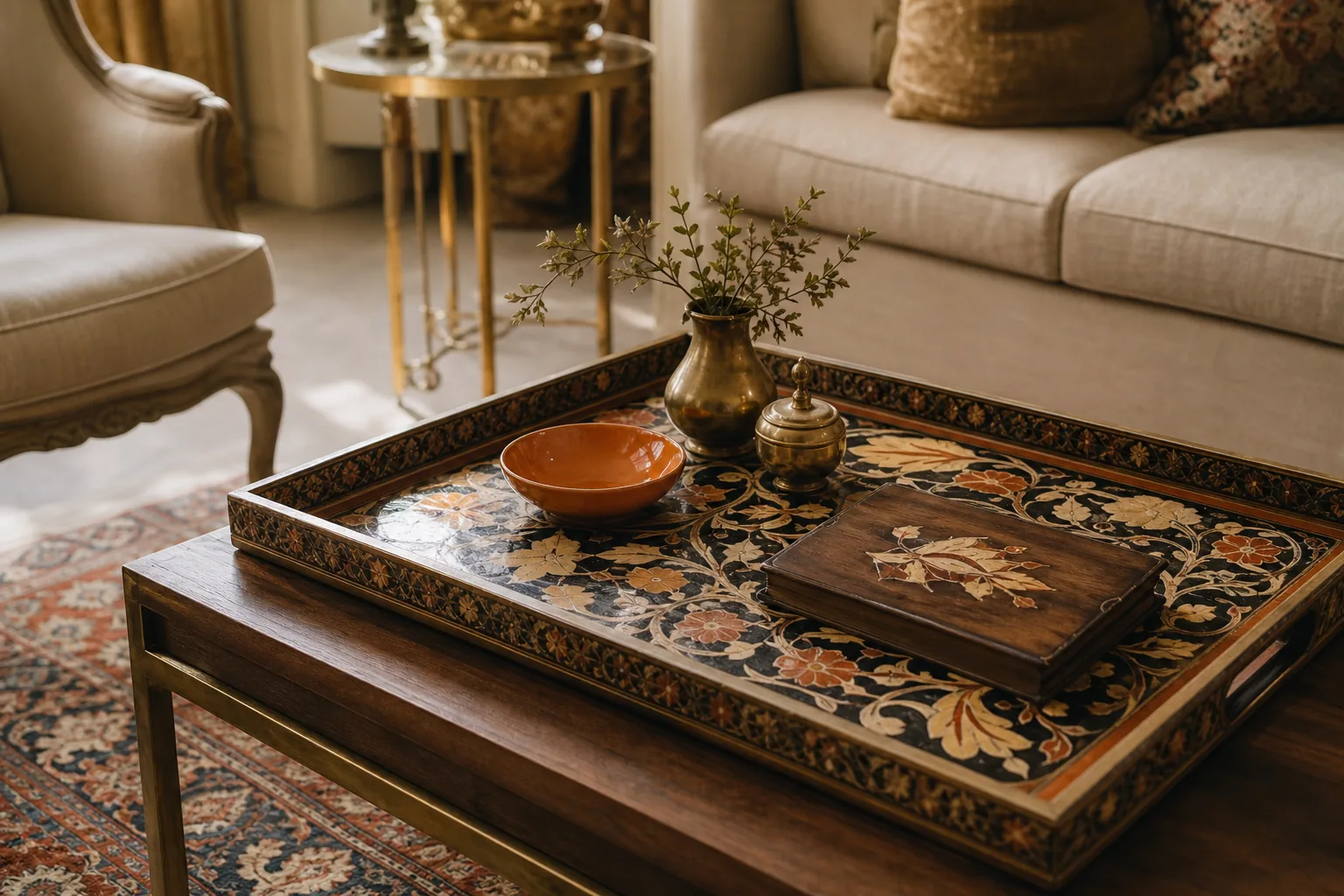
That placement reverses the usual hierarchy in a useful way. The tray is not always something hidden beneath other decor. It can be the focal surface that gives the rest of the display its scale.
Research gathered for this topic found that five of thirteen placement mentions put decor “on the tray.” That makes the tray the most common staging surface in the sample. The only named tray was placed directly on the table, which is a good reminder to treat the base as an object in its own right.
Make the base easy to lift. A dual-purpose tray lets you clear the table before dinner without taking apart the whole arrangement. For more detail on this approach, I’ve written about how to style a coffee table tray beautifully.
Step 2: Add Books for Color, Height, and Personality
Books give a coffee table arrangement a low, stable layer. They add color without taking much room, and their covers can tell guests what you care about. Start with one or two books that feel at home in the room.
Place the largest book at the bottom. Add a smaller one above it if the stack feels steady. Keep the spines aligned when you want a quiet look. Turn one book slightly when the room needs a softer, less formal feel.
Color deserves a close look. A stack in pale neutrals can sit well in a calm room. A dark blue, terracotta, or green cover can pull a small accent color across the space. Don’t match every object. Repeat one tone instead. That keeps the display connected without making it look planned by color chart.
Books also work as risers. A candle can sit on the top cover. A small box can sit beside the stack. A book stand can raise an open page or a slim artwork so it becomes part of the conversation rather than a flat rectangle.
The height change should be modest. A stack that is too tall gets in the way when someone reaches for a drink. The aim is to lift one object enough that it can be seen from the sofa.
When I style a collectible box from Pilardi, I may place it beside a book stack instead of on top. The contrast matters. The book gives the eye a broad, quiet plane. The box supplies the detail. A khatam piece can show its geometric pattern without competing with a busy pile of objects.
Khatam-kari is a form of marquetry made with small slivers of wood, brass, and bone assembled into geometric star patterns. You can see why a quiet book cover works well beside it. The object has enough detail of its own.
Keep the books useful. If you reach for one often, leave it within easy reach. If a book is precious or fragile, place it where hands won’t catch its corners. A coffee table is part of daily life, so the display should allow use rather than punish it.
For a small table, one strong book may be enough. For a wide rectangular table, a stack can anchor one side while a second group balances the other. Don’t fill the whole surface yet. The next layers need room.
Step 3: Layer Light and Greenery for Warmth
Light and greenery keep a coffee table arrangement from feeling flat. Add one source of glow, then bring in a plant or cut stems for movement and texture.
Set the candle on the book stack or inside a small group on the tray. A candle with a low profile works well when the table is used often. A taller candle can create a stronger vertical line, but it should not block the view across the room.
Place the snuffer beside the candle if you use one. This keeps the tool close and makes the arrangement feel considered. It also prevents the candle from becoming a purely decorative object that has no place in the room’s routine.
For homes with children or pets, choose a stable vessel and keep flames away from loose paper or fabric. A rechargeable lamp can give you the same warm layer without an open flame. On a formal table, a small lamp can become the tallest object in the group and provide light during late conversation.
Greenery should add shape, not create a wall. A small plant with leaves that move to one side can make an asymmetrical arrangement feel natural. Short stems in a simple vase work when the rest of the display already has height.
Fresh greenery is not your only choice. Faux stems can work if their finish looks believable from the sofa. Dried stems add line and color but need room around them. Avoid a dense bunch that hides the books or the tray.
One useful method is to repeat the sequence shown in many styling demonstrations: place the base first, then add books, a plant, coasters, and a candle. The exact order is less important than the layers. Each new object should either add height, texture, light, or use.
At Pilardi, a hand-painted tray can hold a candle beside a small box or a pair of coasters. The tray’s wood, brass, and bone details bring more than one material into the scene. That can give a natural arrangement a sharper point without relying on many metallic accents.
The material notes in the research were limited, but woven pieces appeared more than once. Gold appeared only once as a listed accent. I take that as a styling prompt, not a rule: natural texture can do most of the work, while a small glint of brass has more impact when it is used with restraint.
Step 4: Mix Functional Pieces With Collectible Accents
The best coffee table displays leave space for real life. Add at least one piece that earns its place through use, then pair it with an object chosen for its craft or meaning.
Coasters are the easy starting point. Keep them on the tray so guests can find them without moving the display. A small bowl can hold keys or loose items. A covered box can hide remotes while keeping the surface calm.
A basket placed beside the table can do the same job when the tabletop is small. If the table has room, a lidded box gives you storage without the woven bulk. The right choice depends on what gathers in your room each day.
Then add one collectible accent. It might be a hand-painted tray, a khatam box, a small mirror used as a reflective base, or a decorative game board that can be brought into play. The object should have a reason to be there beyond filling a gap.
This is where provenance changes the feel of the arrangement. At Pilardi, every piece is one-of-one. Specialist artisans handcraft the pieces, and I curate and ship them from Paris. A decorative object can be displayed, gifted, played with, or collected. It does not need to look like a mass-made prop.
A small khatam box works well beside books because its surface rewards a closer look. The Handmade wooden decorative box, Tazhib Khatam combines a hand-painted Tazhib design with khatam marquetry. Use it to hold a small personal item, or leave it closed as a quiet object with detail.
Game boards bring another kind of function. A luxury chess and backgammon board can sit on a broad table when the room welcomes play. It should have enough clearance around it to open or move pieces. Don’t bury it under candles and small decor if you want people to use it.
Functional pieces also help you edit. If the remotes have a home, you don’t need another bowl. If guests already have coasters, don’t add a second set just to fill a corner. A good arrangement can be spare.
Think about the hand that will reach into the display. Leave a clear path to the cup, book, or remote. Fragile objects belong farther from the main traffic line. The table will look better when its design works with the way your household moves.
Step 5: Arrange in Groups and Vary the Heights
Grouping turns scattered objects into a composition. To decorate a coffee table well, build two or three small groups rather than spreading single pieces across the whole surface.
Start by placing the tray as one group. Add the books and candle as a second layer within it. Put the greenery slightly to one side if you want an asymmetrical look. A small box or coaster set can complete the group without crowding it.
On a large rectangular table, make a second group at the opposite end. A stack of books with a bowl can hold remotes. A lamp or tall vase can provide the higher point. Keep a strip of open table between the groups so the arrangement can breathe.
For a square table, picture four invisible sections. Place one small vignette in two or three sections, leaving the rest open. This gives the surface order without making every corner match.
A round table usually needs less. One centered object with enough scale may look stronger than several small groups. If you use more than one object, keep the arrangement compact so the circular edge remains visible.
Now check the height pattern. You want a tall point, a middle layer, and a low point. These heights are relative. A lamp can be tall beside books. A box can be medium beside a coaster. A tray can be low while still acting as the broadest shape.
Try a book stand when you need a taller focal point without adding another large object. It can display an open book or artwork and gives the eye a reason to pause. On a formal table, this may work better than adding more small ornaments.
Many people use groups of three because three objects can make a clear visual triangle. But don’t force three items when two already feel balanced. A pair can work well when the objects differ in height or weight.
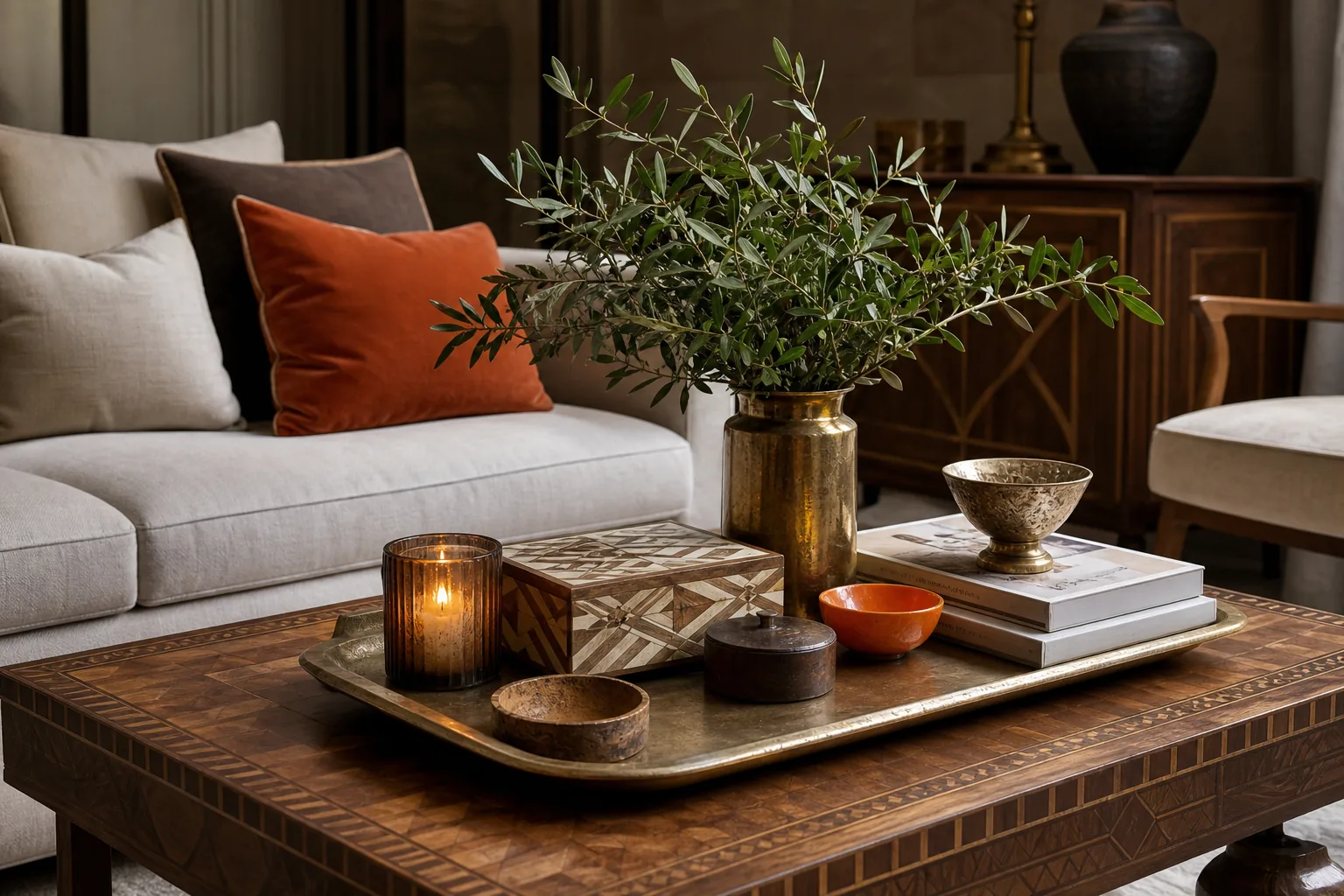
Stand up and view the table from each seat. A composition that looks balanced from above may feel lopsided from the sofa. Move one object at a time. Small shifts usually do more than adding another piece.
Use contrast with care. A pale object against dark wood will pop. A deep indigo piece can settle a light room. A brass detail can catch light, but too many bright points make the display noisy.
Once the groups feel clear, stop. The last object is often the one that makes a good arrangement feel crowded.
Step 6: Edit for the Room and Refresh It Seasonally
The final step in how to decorate a coffee table is to remove what does not belong. Look at the table with the whole room in view. The surface should relate to the sofa, rug, walls, and nearby shelves.
Match the mood, not every color. A room with soft linen and pale wood may suit a quiet tray with warm paper tones. A darker room can take stronger contrast through an indigo mirror, a brass detail, or a patterned box. Let one object bring character instead of asking every item to do it.
Scale matters too. A large round table can handle one substantial centerpiece. A small square table needs a tighter group. A long rectangular table may need two groups, but keep the center open if people sit across from each other.
Check sight lines from the seats. You should be able to see the person opposite you. You should also be able to reach a drink without leaning around a tall vase or lamp.
Now make seasonal changes small. Replace the greenery when the season shifts. Change the candle color or scent. Add a modest seasonal object rather than rebuilding the table each month.
- In autumn, use a warm-toned textile or a small natural object.
- In winter, bring in deeper color and a soft source of light.
- In spring, use fresh greenery or lighter stems.
- In summer, reduce the number of pieces and let the table surface show.
A hand-printed textile can also act as a base layer under a tray. Ghalamkari is a hand-block printed textile craft, so the pattern can bring color and touch without adding another hard object. Fold the cloth so it frames the tray rather than covering the whole table.
Before each refresh, clear the table completely. Wipe the surface, inspect the underside of each object, and return only what still fits the room. This small reset is easier when the tray can lift away as one group.
I use this pause to ask three questions: Does the piece have a use? Does it add a needed shape or texture? Would I still want to see it tomorrow? If the answer is no, put it away.
Collectible decor deserves care. Keep hand-painted surfaces away from spills. Lift boxes and trays rather than dragging them. Use a soft dry cloth unless the product’s care notes say otherwise. The aim is to let the objects age well while the room continues to be used.
FAQ
What should I put on my coffee table first?
Start with a tray or another clear base. It sets the footprint for your arrangement and keeps smaller objects from looking scattered. When you decorate a coffee table, let the tray stand on its own before adding books, greenery, candles, or useful pieces.
How many items should be on a coffee table?
Most coffee tables look best with two or three small groups rather than a fixed item count. A tray can hold books, a candle, and coasters, while a second group holds a bowl or box. Leave open space for drinks and daily use, especially on a small table.
How do I decorate a round coffee table?
Keep a round coffee table fairly compact and consider one centered object with enough scale. A tray, large bowl, or low centerpiece can work well. If you add more pieces, group them closely so the circular edge stays visible and the arrangement doesn’t spread into a loose ring.
How do I hide remotes on a coffee table?
Use a covered bowl, a lidded box, or a small basket to hide remotes. Place the storage piece near the edge where people can reach it. A decorative box can keep the table calm while adding craft and texture, which makes it more useful than leaving remotes loose.
Can I use collectible decor on a coffee table?
Yes, collectible decor works well on a coffee table when it has space around it and can be handled safely. Pilardi pieces are one-of-one objects handcrafted by specialist artisans. Use a tray, box, mirror, or game board according to its scale and the way your household uses the room.
How often should I change my coffee table decor?
Change small details when the room or season changes, rather than replacing every object. Swap greenery, candles, or a textile while keeping a favorite tray or box in place. This keeps the display fresh and preserves a clear visual thread across the year.
My recommendation is simple: choose one strong base, add books and greenery, then bring in one object with genuine craft or meaning. Start by clearing your table and placing the tray alone. If you want that first layer to carry more character, explore Pilardi’s one-of-one decorative pieces, curated and shipped from Paris.


