
Guides
Persian Decor: How to Style It With Intention

Persian decor works best when it doesn't try to be a theme. One well-placed khatam box, a hand-painted mirror in an entryway, a block-printed tablecloth on a dining table: each piece carries enough presence to anchor a room without demanding that everything else match. The objects here are handcrafted, curated in Paris, and shipped worldwide from Paris.
What Makes Persian Decor Distinct From Other Artisan Traditions
Most artisan traditions produce objects that are decorative by accident. Persian craft traditions produce objects that are decorative by design. The distinction matters when you're choosing what to bring into a home.
Specialist artisans work on objects meant to be used and seen at the same time: a mirror you look into, a box you open, a board you play on, a cloth you eat from. The object serves a function and carries a visual language built from geometry, garden motifs, birds and repeating patterns that recur across different materials and techniques.
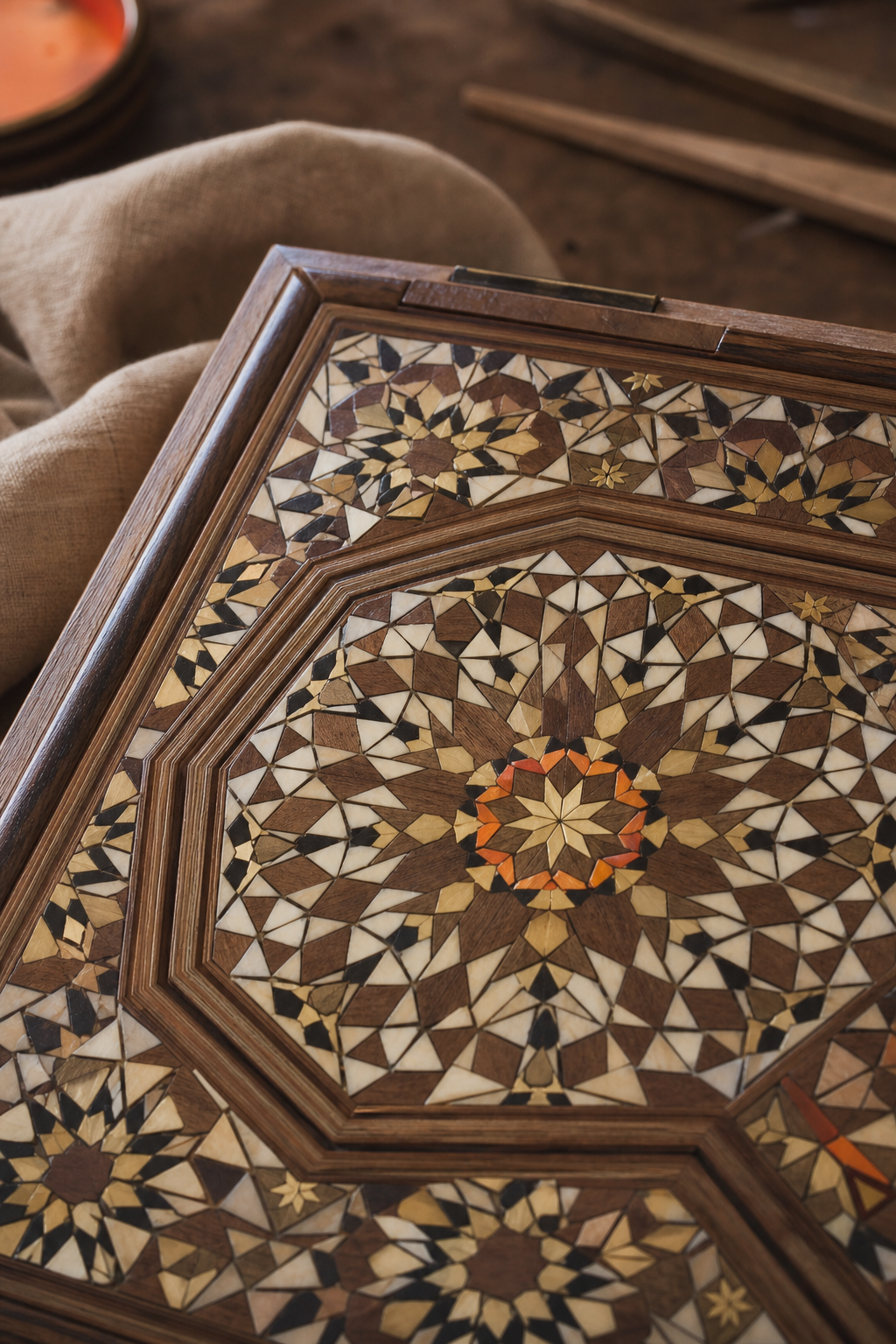
What separates this work from other artisan traditions isn't ornamentation alone. It's the density of decision-making inside each piece. A khatam surface, for example, is built from fine rods of wood, bone and brass, bundled together, sliced, then hand-assembled into repeating geometric patterns before a single object takes shape. The geometry is embedded in the material.
This is also why these objects tend to hold their visual weight even in spare, modern interiors. They don't need surrounding context to read as intentional. A single piece, placed deliberately, does the work.
The Core Crafts: Khatam-Kari, Ghalamkari, and Tazhib Explained
Understanding the craft families behind Persian objects helps you choose pieces that are actually what they claim to be, and care for them properly once you own them.
Khatam-Kari
Khatam-kari is marquetry. An artisan cuts fine rods of wood, bone and brass, bundles them together, then slices the bundle across so that each slice reveals a geometric star. Those slices are hand-assembled into sheets and applied to a wooden base. Some pieces also carry mother-of-pearl.
The result is a surface that reads differently depending on the angle you look from: the brass catches the light, the bone stays pale, the wood carries the warmer tone. No two finished surfaces are identical, because the assembly is done by hand.
At Pilardi, khatam-kari appears on chess and backgammon boards, collector boxes, pen holders and writing accessories. Browse the khatam collector boxes and the khatam desk and writing accessories, including the Full Khatam Pen Holder and the Hand-Painted Desk Pen Stand, to see how the technique scales from small keepsake pieces to larger collector editions.
Ghalamkari
Ghalamkari is Persian hand block printing on textile. A carved wooden block is inked and pressed onto cotton by hand, one colour and one block at a time. The patterns, typically floral, paisley or geometric, build up through repeated printings. Slight offsets between passes are not errors. They are evidence of the hand.
At Pilardi, ghalamkari is used on the cotton textiles: the hand-printed tablecloths, spreads such as the Firouzeh Spread, and the block printed cotton cushion covers. One point worth being clear about: ghalamkari is not the decoration on the boards or the boxes. Those are khatam marquetry and hand-painted work.
Tazhib
Tazhib is the Persian art of illumination, a gold-and-pigment ornament historically used on manuscript pages. On Pilardi pieces it is hand-painted onto wood: mirror frames, box lids and game boards. There is no gold leaf involved anywhere in the collection. The warm golden tones are painted.
You can see tazhib on the Hand-Painted Tazhib Mirror in indigo and on the Tazhib Chess & Backgammon Set in indigo.
Pilardi mirrors come from two of these painted families: hand-painted relief enamel, and tazhib. Both are painted by hand, one piece at a time.
How to Choose Persian Decor Pieces for Your Space
The most common mistake people make with Persian objects is choosing too many. A room with a Persian rug, Persian cushions, a Persian tray and a Persian mirror stops reading as curated and starts reading as a catalog display. One or two pieces, chosen deliberately, carry more weight than six chosen loosely.
Start With What the Room Lacks
Most contemporary interiors are good at flat surfaces and neutral tones. What they often lack is texture that holds up at close range and pattern that rewards looking. Persian craft objects address both. A khatam box on a shelf adds surface complexity. A hand-painted mirror adds pattern that changes as you move past it.
Ask what the room already has in abundance before adding a Persian piece. If the room is already full of pattern, a khatam object that reads mostly as wood tone with brass highlights integrates more cleanly than a tazhib-painted mirror. If the room is spare, the mirror may be exactly what it needs.
Match the Craft to the Function
Textiles go where textiles go: dining tables, console tables, bed throws, coffee table layers. A ghalamkari tablecloth works on a table that gets used, whether that is the Indigo tablecloth at 80 by 80 cm, the round 81 cm tablecloth, or the longer Monochrome Floral tablecloth at 206 by 136 cm.
Mirrors go where light matters: entryways, salon walls, above a console. The hand-painted Persian mirrors are not large architectural mirrors. They are objects you hang the way you would hang a painting, for the frame as much as for the reflective surface.
Boxes and trays belong on flat display surfaces: shelves, desks, consoles, side tables. Look at the collector boxes and the trays and home accents, including the Hand-Painted Decorative Tray. They hold things or they don't. Either way, they read as objects worth noticing.
Pair Pattern With Calm
The standard principle for placing intricate Persian objects in a contemporary room: give them a calm neighbour. A khatam box on an otherwise empty shelf reads clearly. The same box squeezed between a printed plant pot and a stacked row of books disappears. Persian pattern needs breathing room to register.
Neutral surfaces, whether linen, stone, pale wood or white plaster, let these pieces hold their own without competing. This is why the collector's instinct to mix a traditional craft object into a modern interior often works better than a room styled to match.
Interior designers working with one-of-a-kind pieces can find more about Pilardi's trade approach on the trade and interior designers page.
Persian Decor as Functional Art: Mirrors, Boxes, Textiles, and Game Boards
The phrase "functional art" is used loosely in most contexts. In Persian craft, it describes something specific: objects built to be used that are also built to be looked at, with no hierarchy between the two purposes.
Mirrors
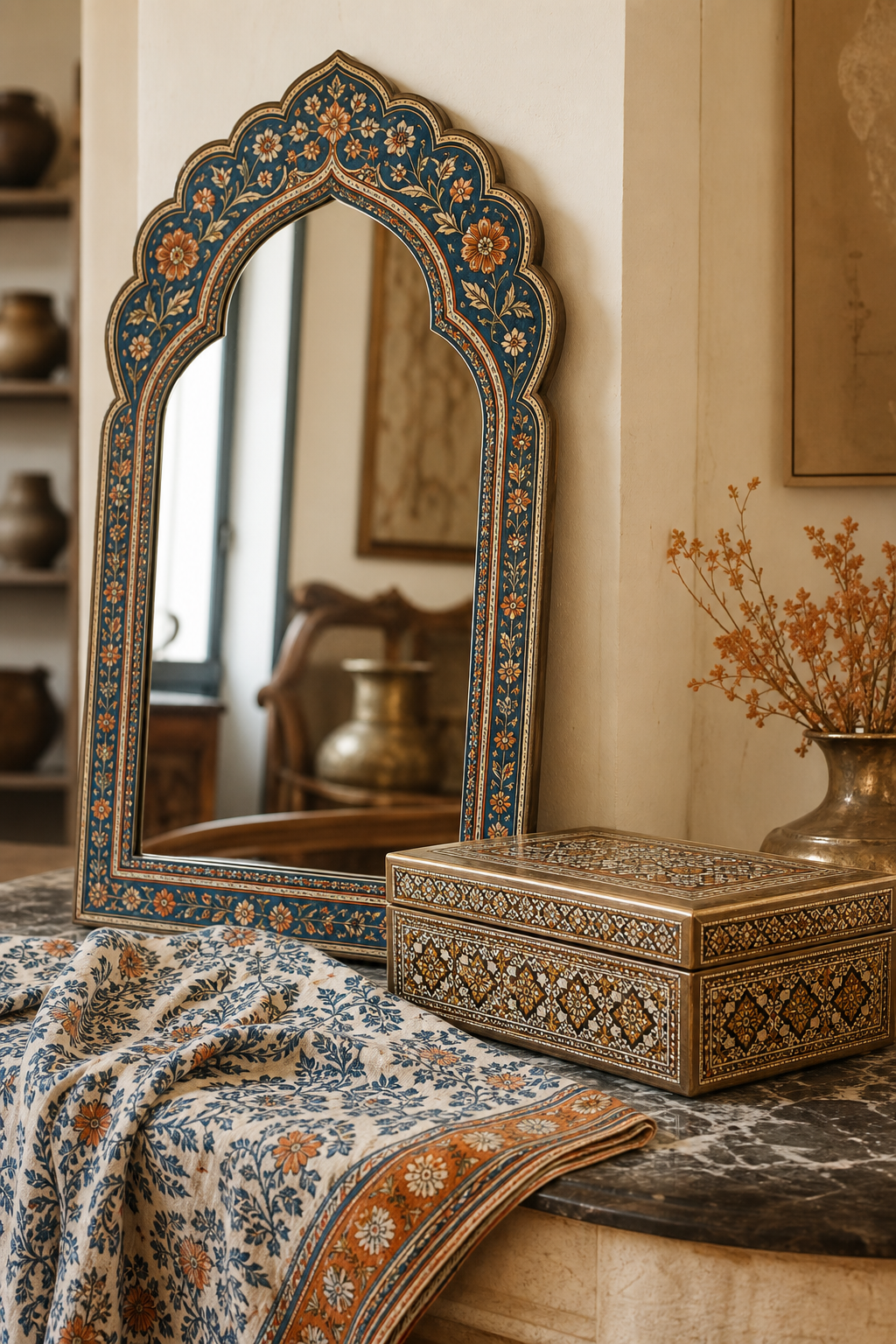
A hand-painted Persian mirror is not a full-length dressing mirror. It is closer in scale to a framed artwork. Across the current collection, the pieces run from roughly 23 cm to 50 cm on the longer side, from the small Bird & Bloom relief mirror at 23 by 19 cm up to the Bird & Bloom relief mirror at 50 by 40.5 cm. The frame carries the craft, either hand-painted relief enamel or tazhib. The mirror itself is secondary to the surround.
In an entryway, one mirror at eye height on a bare wall is enough. In a salon with high ceilings, a pair hung symmetrically reads as architectural. Either way, the object is doing the work a painting would do, with the added quality of reflecting light back into the room.
Boxes
The boxes range from small keepsake formats such as the Passori sliding marquetry box at 11 by 8 by 3 cm up to longer jewelry boxes such as the Leili o Majnoun miniature box at 20 by 7 by 5 cm. They are wood, decorated with khatam marquetry, hand-painted miniature work, or both, and some are lined with velvet. See the Simin khatam jewelry box and the Passori big star khatam keepsake box for the two ends of that range.
The Pilardi collection includes boxes in a range of formats, from compact pieces with sliding marquetry lids to larger statement editions. Every piece is one-of-one or made in a very small series, and that variation between pieces is part of what makes them worth collecting rather than simply buying.
Textiles
Ghalamkari textiles are the most accessible entry point into Persian decor for most homes. A block-printed tablecloth on a dining table changes the room without requiring any permanent change to the space. Folded as a runner, the same cloth reads differently than spread flat. The Pilardi ghalamkari range includes square and round tablecloths, longer rectangular cloths, cotton spreads and cushion covers, all hand block printed in specialist workshops on cotton.
The hand block printing process, which uses carved wooden blocks applied one colour at a time, produces slight registration variation between colours. This is not a flaw. It is the visible evidence of the hand, and it is what separates a hand-printed textile from a digitally printed reproduction.
Game Boards
A chess and backgammon board made with khatam marquetry is functional on both counts: it plays correctly and it displays well. Closed, it reads as a decorative box on a coffee table or shelf. Open, the board surface shows the pattern continuing across the playing field.
Every board in the chess and backgammon collection is made of walnut wood, decorated with khatam marquetry, tazhib painting, or both, and finished under a clear protective resin. The Khatam Chess & Backgammon Set, Golden Edition takes its name from the warm golden tones inside the khatam inlay, not from any gold leaf. Alongside it sit the Black Edition, the Polo Miniature khatam set, and the compact 34 cm khatam and tazhib set for smaller tables. Checkers can be matched separately, for example the Premium Khatam Backgammon Checkers Set.
This is the category where the "made to be played" principle is most literal. These boards are made for use, not only display. Putting one on a coffee table and actually playing on it is the correct way to own it.
Caring for Handcrafted Persian Pieces
Handcrafted objects need slightly different handling from factory-finished goods. The rules are not complicated.
Khatam and Painted Wood Surfaces
The boards, boxes and desk pieces are sealed under a clear protective resin finish. That finish does the protecting, so there is nothing to feed: do not oil, wax or polish these surfaces, and do not use solvents or abrasive cleaners on them. A soft dry cloth, or a barely damp one, is all they need.
Never submerge or soak a piece. Keep wooden objects away from standing water, kitchen humidity, outdoor conditions and long stretches of direct sunlight.
Hand-Painted Mirrors
The risk with a painted mirror is mechanical rather than chemical: a sharp knock to the frame can chip the painted surface. Handle mirrors by the sides rather than the front, and hang them on fixings rated for the weight.
To clean the glass, apply glass cleaner to a soft cloth rather than spraying it onto the mirror. Overspray onto a hand-painted frame is worth avoiding.
Ghalamkari Textiles
Store the cotton textiles folded and out of direct light. A ghalamkari tablecloth kept folded in a drawer for months will come out looking as it went in. If you are unsure how to launder a particular piece, ask us before washing it via the contact page rather than guessing.
FAQ
What is Persian decor, and how is it different from general Middle Eastern decor?
Persian decor refers specifically to design objects and craft traditions from Persia. The craft families named here, khatam-kari marquetry, ghalamkari block-printed textiles and tazhib illumination, are technically specific to that tradition. General "Middle Eastern" decor is a broader and less precise category that mixes traditions from very different regions and craft histories.
Can I use Persian decor objects in a minimalist interior?
Yes, and it often works better than in a maximalist one. A single khatam box or hand-painted mirror on an otherwise bare surface reads as a deliberate collector's choice. The key is giving the piece enough visual breathing room. Minimalist interiors with pale walls and neutral furniture are a good foil for intricate Persian pattern, because there is nothing competing with it.
How do I know if a piece is genuinely hand-made?
With khatam, look for slight variation in the star alignment at joins and edges, since hand assembly produces small inconsistencies that printing cannot replicate. With ghalamkari textiles, slight colour registration offsets between printed passes are a sign of genuine hand block work. Beyond the object itself, provenance matters: every Pilardi piece is handcrafted, curated in Paris, and made as a one-of-one or in a very small series.
What is the easiest Persian decor piece to start with?
A ghalamkari tablecloth is the most usable starting point. It is functional on a dining table and adds pattern without requiring any permanent change to the room. A small khatam keepsake box is the easiest object to place, since it fits on any shelf or desk. Both ship worldwide from Paris.
Where should I place a hand-painted Persian mirror?
Entryways and salon walls are the best placements. These mirrors are modest in scale, which suits a wall space the way a framed painting would. They work at eye height on a bare wall, above a console table, or in a grouping with other objects. Avoid placing them where steam or high humidity can reach the frame regularly.
Conclusion
The strongest approach to Persian decor is also the simplest: one piece, placed with intention, in a room that gives it room to breathe. If you are starting out, a ghalamkari tablecloth or a small khatam box is the right scale. If you are adding to an existing collection, a hand-painted mirror or a walnut marquetry game board changes what a room does without changing its architecture.
Shop the full Pilardi collection. Every piece is handcrafted, curated in Paris, one-of-one or made in a very small series, and ships worldwide from Paris.


