
Guides
How to Play Backgammon for Beginners

Backgammon looks simple until one small rule changes your whole turn. You may not bear off a checker just because the dice seem to allow it. I’ll walk you through the board, the dice, hits, the bar, bearing off, and the first habits worth building.
Step 1: Set Up the Board and Start the Game
The goal is to move all 15 of your checkers into your home board, then remove them before your opponent does. This is the first part of learning how to play backgammon for beginners, so take a moment to get the layout right.
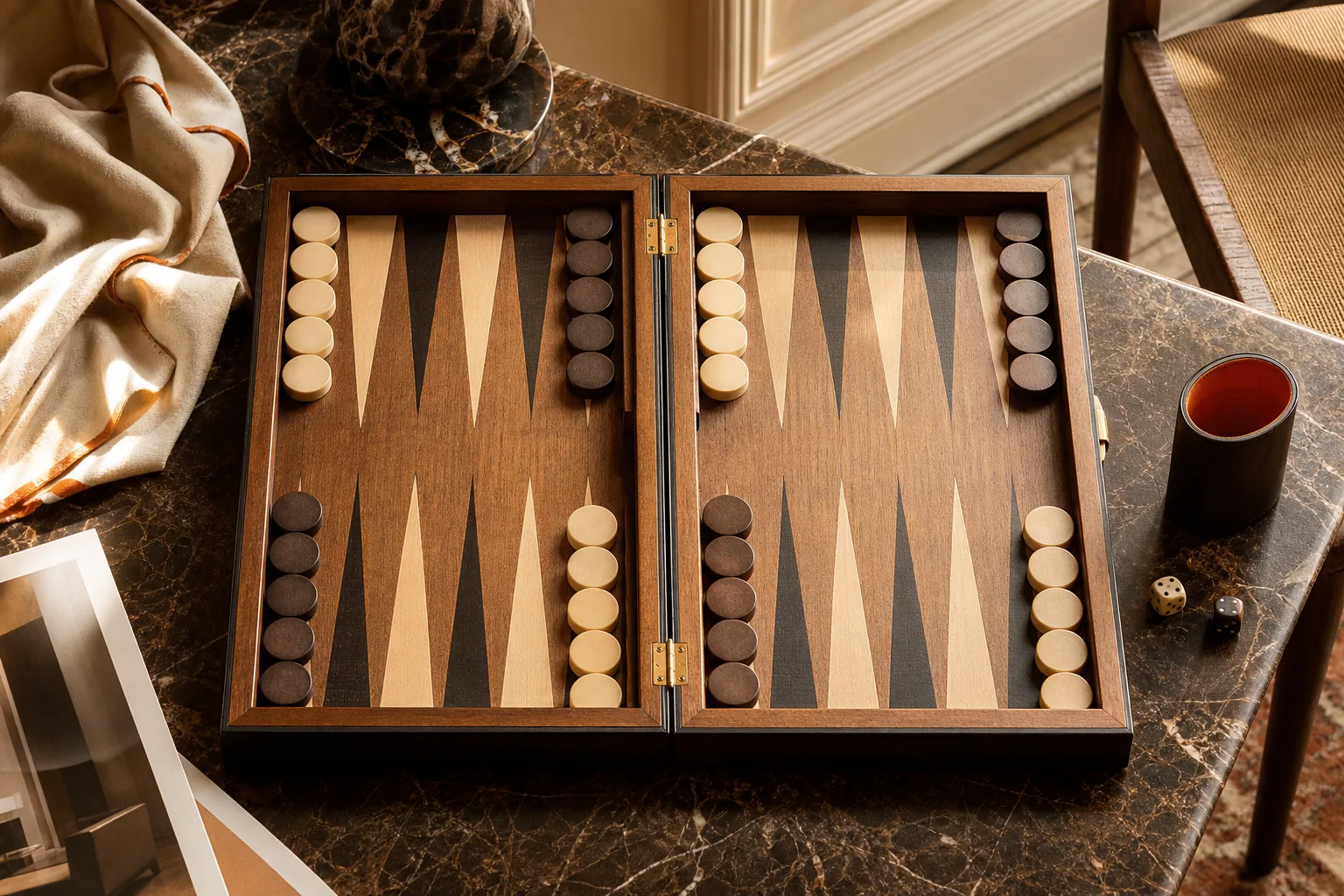
A backgammon board has 24 narrow triangles called points. Six points make one quadrant, so the board has four quadrants split by the bar in the middle. The point colors are decorative. They don't decide where a checker may move.
Each player takes 15 checkers in one color. Number the points from 24 down to 1 along your route. Place your checkers in this pattern:
- Two checkers on the 24-point.
- Five checkers on the 13-point.
- Three checkers on the 8-point.
- Five checkers on the 6-point.
Your opponent uses the same pattern in reverse. If you want a visual check before playing, Pilardi’s backgammon board setup guide shows the starting points, the bar, and the direction of play.
Your checkers move in one direction around the board. Your opponent moves the other way. Your home board is the last group of six points your checkers reach. You can't bear off until all 15 checkers are there.
For a first game, set aside the doubling cube. You need two dice per player, though one pair can be shared. A dice cup helps keep rolls fair. Roll both dice so they land flat on the playing surface. If a die lands off the board or rests at an angle, agree to reroll it before you begin.
To choose the first player, each person rolls one die. The higher number goes first and uses both numbers shown for the opening move. If the rolls tie, both players roll again until one player has the higher result.
By now you should have: a board with 30 checkers in place, a clear home board for each player, and a player who will make the first move.
Step 2: Roll the Dice and Make Legal Moves
Once you know how to play backgammon for beginners at setup, the main turn is easy to repeat. Roll, choose legal moves, complete as much of the roll as the rules allow, then end your turn.
Each die is a separate move. If you roll a 5 and a 3, you may move one checker five points and another checker three points. You may also move one checker five points, then three more, if both landing points are legal.
Count points, not the raised bar. A checker may land on:
- An empty point.
- A point with any number of your own checkers.
- A point with one opposing checker.
You may not land on a point with two or more opposing checkers. That point is blocked. Your checker also can't jump over the block when a move ends there. If you want to use both dice on one checker, resolve the first move before making the second. The intermediate point must be open too.
For example, a 2 and 5 is not automatically a seven-point move. If the two-point landing spot is blocked, you can't use the two first on that checker. If the five-point landing spot is blocked, you can't use the five first either. Look for another checker or another order.
Try to use both numbers when possible. If only one number can be played, you must play it. If either die works but both cannot fit in the same turn, use the larger number. If neither die has a legal move, you lose the turn.
A roll of matching numbers is called doubles. Double 4 gives you four moves of four points, not two moves of four. You can spread those four moves across several checkers, or move one checker four times. Every move still needs a legal landing point.
When your checker lands on a point with one opposing checker, you hit it. That lone checker is called a blot. Move it to the bar. Hitting can open a route, but don't hit without checking what your opponent can do next.
A pair of your checkers on one point is often called an anchor. A long connected run of blocked points is called a prime. You don't need these terms to play your first game, but they help when another player explains a move. A blot is exposed. An anchor gives you a safe foothold.
Backgammon involves balancing speed and safety. For a beginner, that means don't ask only, “How far can I go?” Ask, “What can my opponent hit after I move?”
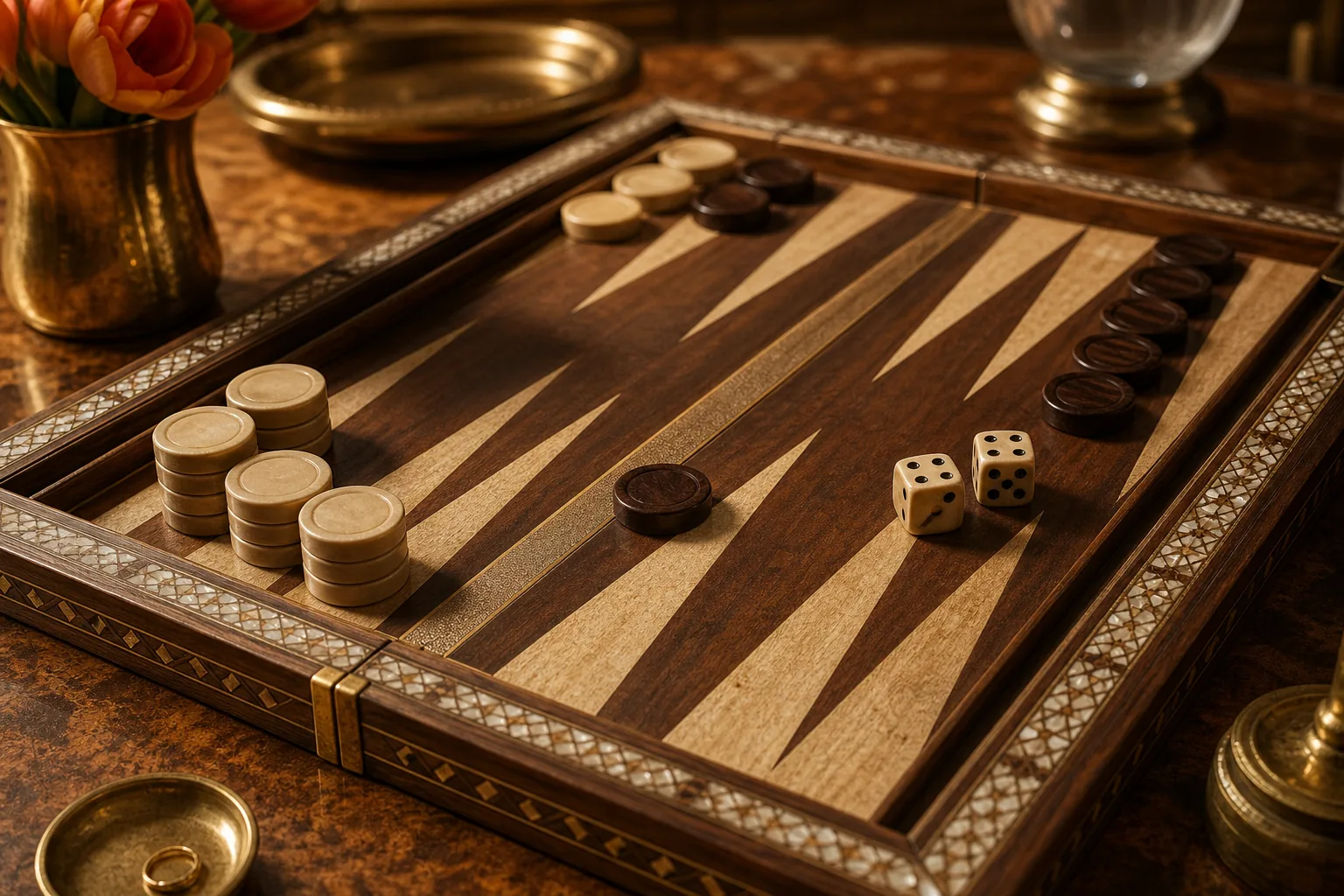
By now you should have: a repeatable turn routine. Roll the dice, test each move, use both numbers when possible, and place any hit checker on the bar.
Step 3: Re-Enter Checkers from the Bar
Learning how to play backgammon for beginners becomes much easier once the bar rule is clear. A checker on the bar must return to the board before you move any other checker.
When your checker is hit, place it on the bar. On your next turn, use the dice to re-enter it into your opponent’s home board. Count that home board as points 1 through 6 from your entry side. A roll of 4 lets you enter on the opponent’s four-point, if that point is open.
An entry point is open when it has no opposing checker or only one opposing checker. If you enter on a lone checker, you hit it and send it to the bar. If the point has two or more opposing checkers, it is blocked.
Suppose you roll a 4 and 6 while one checker sits on the bar. Check the four-point first and the six-point next. If the four-point is open, enter there. Then use the 6 for another legal move, if one exists. You cannot move a checker already on the board before entering the checker from the bar.
If you have two or more checkers on the bar, you must enter as many as the dice permit. If both entry points are blocked, you make no move and lose the turn. This can happen even with doubles. A large roll is useless when every entry point it reaches is closed.
Being hit also interrupts bearing off. You must enter the checker, move it through the board, and bring it back to your home board before you can resume removing checkers.
That is why a safe home-board position matters late in the game. A hit at the wrong time can force a long trip while your opponent keeps bearing off.
Step 4: Bear Off, Score the Game, and Know When You Win
Bearing off is the final phase. You may start only after all 15 checkers sit inside your home board. The first player to remove every checker wins the game.
During each bearing-off turn, roll both dice and use them as normal. A checker on the six-point can leave with a 6. A checker on the two-point can leave with a 2. You may also use a die for a legal move inside your home board instead of removing a checker.
Here is the rule that surprises many new players: you don't have to bear off if another legal move is available. If you roll a 3 and have a checker on the three-point, you may remove it. But you may choose an ordinary legal move instead.
If no checker sits on the exact point for a die, look at the higher points. You may remove a checker from the highest occupied point only when no checker sits on a higher point than the number rolled. For example, if you roll a 5 but your highest occupied point is the three-point, you may remove a checker from the three-point.
Keep the move rules in place while bearing off. You still can't land on a blocked point. You can still be hit. If a checker leaves the home board and reaches the bar, bearing off stops until that checker returns home.
In a single game, a normal win counts as one point. If the loser has borne off no checkers, the winner scores a gammon, worth two times the cube value. If the loser still has a checker on the bar or in the winner’s home board, the result is a backgammon, worth three times the cube value.
The doubling cube changes the score, not the movement rules. Before rolling at the start of a turn, a player may offer a double. The opponent may accept and take ownership of the cube, or decline and lose the current point value. New players can leave the cube aside until they understand the board.
Backgammon uses 24 points, has two players, and includes bearing off and scoring terms.
Step 5: Play Your First Game with Sound Beginner Habits
Your first game should focus on legal turns rather than clever traps. Use the same short checklist before every move.
- Check whether you have a checker on the bar.
- Look at both dice separately.
- Find blocked points before choosing a checker.
- Check whether your move leaves a blot exposed.
- Use both dice when the rules require it.
- Pick up the dice when your turn ends.
Dice etiquette keeps the game clean. Roll both dice from a cup or from the same hand. Keep them on the board. Don't move checkers while deciding whether a roll is legal. Once you finish, collect the dice so your opponent knows the turn has ended.
Beginners often make three errors. They count the bar as a point. They treat a 4 and 2 as one six-point move without checking the middle point. Or they move a board checker while one of their own checkers waits on the bar. Stop and correct each error as soon as you see it.
For early-game play, build safe stacks instead of leaving too many blots. In the middle game, look for ways to make consecutive blocked points. In the end game, count the race and protect against a late hit. Don't chase every possible hit. A hit that leaves your own checker exposed may trade one problem for two.
House rules vary. Some groups use automatic doubles on the opening roll, while others don't. Match play also needs an agreed target score. For your first sitting, play one game without the cube. Then add the cube when both players can explain a normal win, gammon, and backgammon.
At Pilardi, I like a board that can stay on the table between games. The Khatam Chess & Backgammon Set, Turquoise Edition is handcrafted by artisans in Isfahan and curated and shipped from Paris. Its khatam-kari work uses fine slivers of wood, brass, and bone assembled into geometric star patterns. It is made to be played, displayed, gifted, or collected.
Every Pilardi piece is one-of-one. That matters when the board will live in a room, not just in a cupboard. Choose a set because you want to use it, then let the craft give the game a lasting place in your home.
Frequently Asked Questions
How many checkers do you start with in backgammon?
Each player starts with 15 checkers. The setup places two on the 24-point, five on the 13-point, three on the 8-point, and five on the 6-point. The opponent mirrors that arrangement. This layout gives both players a matching route toward their own home board.
What happens when you roll doubles in backgammon?
Doubles give you four moves of the number shown. A roll of double 3 means four separate moves of three points. You may use different checkers or move one checker several times. Each step must be legal, and you should use as many of the four moves as possible.
Can you move another checker when one is on the bar?
No. A checker on the bar must re-enter before you move any other checker. Use a die to enter it into the opponent’s home board. If every entry point is blocked, you lose that turn. With two checkers on the bar, enter as many as your dice permit.
When can you start bearing off in backgammon?
You can start bearing off only when all 15 of your checkers are in your home board. Use dice to remove checkers from matching points. If no exact point is occupied, a higher roll may remove a checker from your highest occupied point, but only when no checker sits on a higher point.
Do you have to bear off if the dice allow it?
No. You don't have to bear off. You may make another legal move instead, even when a die matches a checker in your home board. This choice can protect a blot or improve your position. It is one of the first strategic rules worth noticing after you learn the basic movement system.
Should beginners use the doubling cube?
Beginners should usually play the first game without the doubling cube. The cube can double the stakes before a player rolls, and declining ends the game at the current value. Learn movement, hitting, re-entry, and bearing off first. Add the cube once both players can track the score without confusion.
Start with one slow game and say each move aloud. If you want a board that supports both play and display, Pilardi’s one-of-one handcrafted sets give that first game a considered setting while you learn the rules.


